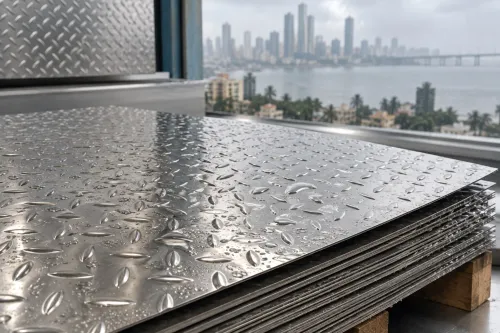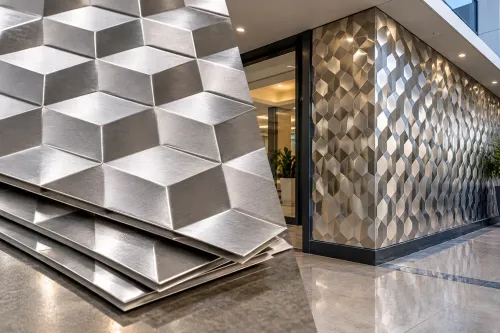

Mumbai entrance panels must deliver a controlled bronze reflection while resisting salt-laden humidity, monsoon water, pollution and intense sunlight. By the end, you will know how to choose the panel build-up, detail joints and drainage, compare finishes, and write an order that fabricators can execute without costly rework.
Key takeaways
- Use drained, supported assemblies for exterior bronze mirror entrance panels.
- Select stainless grade and PVD finish for Mumbai’s exposure conditions.
- Specify seam alignment, protective film and damage checks before handover.
- Record sheet grade, finish, thickness, batch and maintenance instructions.
Where Bronze Mirror Panels Work on a Mumbai Entrance
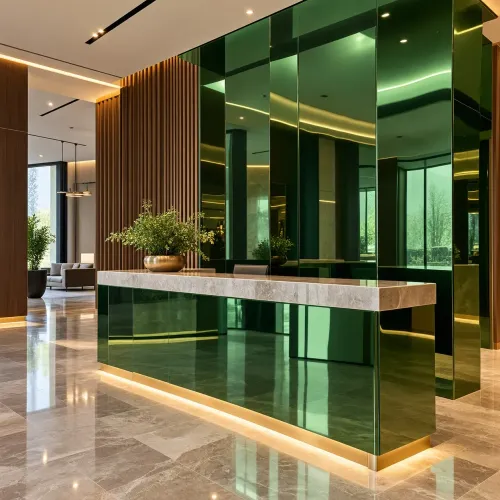
Fascia panels, portal frames, soffits, column wraps, canopy returns and door surrounds benefit most from bronze mirror stainless steel because they create a continuous visual frame around the entrance. Use bronze mirror sheets for exterior entrance panels in Mumbai when the design needs warmth and reflectivity without the weight and softness of bronze metal.
| Entrance element | Visual benefit | Risk to assess |
|---|---|---|
| Fascia and canopy return | Extends the bronze band across the frontage | The sky and traffic may create harsh glare or uneven reflections |
| Portal frame and door surround | Makes the entry read as a single outlined opening | Small alignment errors become obvious beside straight door lines |
| Column wrap | Adds a tall reflective feature at pedestrian level | Fingerprints, scratches and distorted reflections show quickly |
| Soffit | Reflects light into a recessed entrance | Water marks and dark joints stand out if drainage is poor |
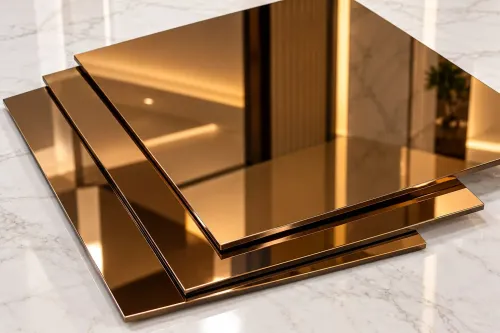
The bronze colour normally comes from a PVD coating over mirror-polished stainless steel, not from solid bronze. Specify the stainless grade, mirror finish, PVD colour, coating test requirements and allowable colour variation as separate items; bronze mirror sheets for building exteriors can look mismatched when panels come from different batches or face different directions.
Approve a full-size sample in the actual entrance lighting. Check reflected signage, neighbouring buildings, seam visibility, panel orientation and glare at eye level. Protective film prevents fabrication scratches, but prolonged sun exposure can leave adhesive residue or produce uneven weathering.
Build the Panel as a Drained, Supported Assembly
Treat the visible sheet as a skin, not a beam. Large bronze stainless steel panels for builders need a formed cassette, tray, honeycomb backing or bonded stiffener system connected to a subframe.
Design that assembly for wind pressure, panel span, oil-canning, thermal movement and the dead load carried by anchors; increasing sheet thickness alone does not prevent distortion or pull-out.
Build the support and water-control details into the shop drawing:
- Keep the sheet continuously supported or stiffened so flat areas cannot drum or buckle between fixings.
- Provide a ventilated cavity behind rainscreen panels, with a clear air path and openings that do not become blocked by sealant or insulation.
- Give horizontal trims and canopy returns a fall, then provide bottom weeps so monsoon water cannot sit behind the panel.
- Use sealed but drained joints; seal the weather line without trapping water inside the cassette.
- Isolate the stainless assembly from carbon-steel brackets and other dissimilar metals with compatible separator pads, sleeves or coatings.
Specify stainless-compatible fasteners and sealants approved for both stainless steel and the PVD finish. Keep carbon-steel dust away during cutting, use non-contaminating tools, and protect drilled holes and cut edges from exposed substrate corrosion.
PVD bronze panels for commercial entrances still need this protection: PVD is thin, so a deep scratch or poorly sealed penetration can reveal the stainless beneath and make a local repair visibly different. Provide access for cleaning and inspection rather than burying the lower edge behind permanent trim.
Choose the Finish and Stainless Grade for Exposure
A visible bronze colour does not mean the panel is bronze metal. For bronze mirror sheets for building exteriors, specify mirror-polished stainless steel, PVD colour, coating test requirements and allowable colour variation as separate items. Bronze mirror PVD sheets for entrances retain a reflective face, but cuts, drilled holes and deep scratches expose the substrate.
| Option | What you get | Exposure and repair decision |
|---|---|---|
| Bronze PVD stainless | Consistent metallic colour over mirror stainless; scratches and panel-joint variation remain visible | Use for premium exterior faces; replace a damaged cassette rather than touch up locally |
| Bronze-coloured metal | Colour is inherent to the alloy or surface finish, not necessarily a mirror PVD face | Confirm corrosion resistance, reflectivity and batch consistency before substituting it |
| Painted steel or aluminium | Opaque colour with easier recoating, but less depth and reflection | Choose where low-cost field repair matters more than a mirror effect |
| Laminate | Decorative film over a substrate; seams, edges and impact damage can reveal the backing | Keep it away from wet, exposed edges unless the system is specifically exterior-rated |
| Anodised aluminium | Colour is formed in the anodic layer; lightweight and corrosion-resistant, but not the same mirror character | Suitable where aluminium framing and lower weight outweigh stainless reflectivity |
Grade 304 is enough for a Mumbai entrance when the panel is drained, ventilated, sheltered from salt spray and cleaned before chloride deposits build up. Choose 316 for seafront sites, exposed canopies, road-salt contamination or persistent wetness. Isolate brackets and fasteners from the sheet, and seal drilled edges without blocking drainage.
Control Reflection, Seams and Fabrication Damage
A mirror face stays credible only when every panel is fabricated to the same datum. Approve a full-size production sample before cutting the batch, then assess it from the agreed viewing distance under daylight and entrance lighting; bronze reflection exposes waviness, dents, roller marks and weld distortion immediately.
- Put door hardware, fastener holes, folded returns, drainage slots and service penetrations on shop drawings. Do not drill or grind the face on site.
- Establish one grain direction and one joint layout for fascia panels, portal frames, soffits, column wraps, canopy returns and door surrounds.
- Use templates and a controlled jig to keep cassette edges, reveals and adjacent reflections aligned. Allow movement at joints without creating an uneven shadow line.
- Protect bronze mirror PVD sheets for entrances with removable film during transport and installation, using clean, non-contaminating tools; remove the film before handover.
- Specify stainless-compatible fixings, sealants approved for the PVD finish and isolation from carbon steel. Staining or galvanic corrosion at a bracket can spoil an otherwise sound panel.
PVD bronze panels for commercial entrances have a thin coating, not a repairable bronze mass. Deep scratches, cut edges, drilled holes and badly sealed joints can expose stainless steel and create local corrosion. Do not field-polish or touch up a damaged face: the colour and gloss will change.
Replace the complete cassette or defined panel instead.
Write a Purchase Specification That Survives Handover
Your purchase order survives handover only when it defines the finished face, the fabricated panel and the evidence supplied with it.
For bronze mirror sheets for exterior entrance panels in Mumbai, do not write only “bronze stainless steel”; identify the substrate grade, thickness, mirror-polish requirement, PVD colour, coating test method, acceptance result and allowable colour variation between sheets and batches.
- Confirm the approved reference sample, sheet dimensions, tolerances, grain direction and which faces may be handled or exposed.
- Require shop drawings showing every fold, cassette edge, joint, fixing hole and service penetration. Cutting, drilling, welding and grinding on site can break the mirror and PVD layers.
- State stainless-compatible fasteners, isolation from carbon steel, non-contaminating tools and sealants approved for stainless steel and the PVD finish.
- Record protective-film type, storage conditions and removal timing. Sun-baked adhesive leaves residue, while retained film causes staining and uneven weathering.
- Require a cleaning and inspection schedule for salt deposits, rainwater marks and brown tea staining around ledges, joints and fixings.
- Agree the remedy for damage: replacing a defined cassette or panel is more predictable than field polishing, which changes reflectivity and rarely matches the original colour.
NIXON STEELIUM LLP can add practical value by supplying control samples, reviewing cut lists and fabrication details, and documenting handling, cleaning and replacement procedures for bronze stainless steel panels for builders. The project designer must still approve appearance, interfaces, drainage, tolerances and performance requirements.
Related product
 | PVD Coated Mirror Stainless Steel Sheets Specification Product Name Stainless Steel Products Steel Type Stainless Steel Steel Product Type Steel Sheets Grade 304 Thickness 0.5-3.0 Millimeter... View product → |
Frequently asked questions
Where do bronze mirror panels work on a Mumbai entrance?
Use them on fascia panels, portal frames, soffits, column wraps, canopy returns and door surrounds where a warm reflective frame is required.
How should builders support and drain exterior bronze mirror panels?
Build a drained, supported assembly with a stable substrate, secure fixings and paths for water to leave behind the panel.
Which stainless grade and finish suit exterior entrance panels?
Choose the stainless grade and bronze PVD finish according to Mumbai’s moisture, pollution, salt exposure and cleaning conditions.
How can builders control reflection, seams and fabrication damage?
Plan sheet orientation, align seams, protect the mirror face during fabrication and inspect edges, corners, scratches and distortion before installation.
What should a purchase specification include for handover?
Record stainless grade, sheet thickness, bronze finish, surface direction, dimensions, edge details, fixing method, protective film requirements and care instructions.
Keywords