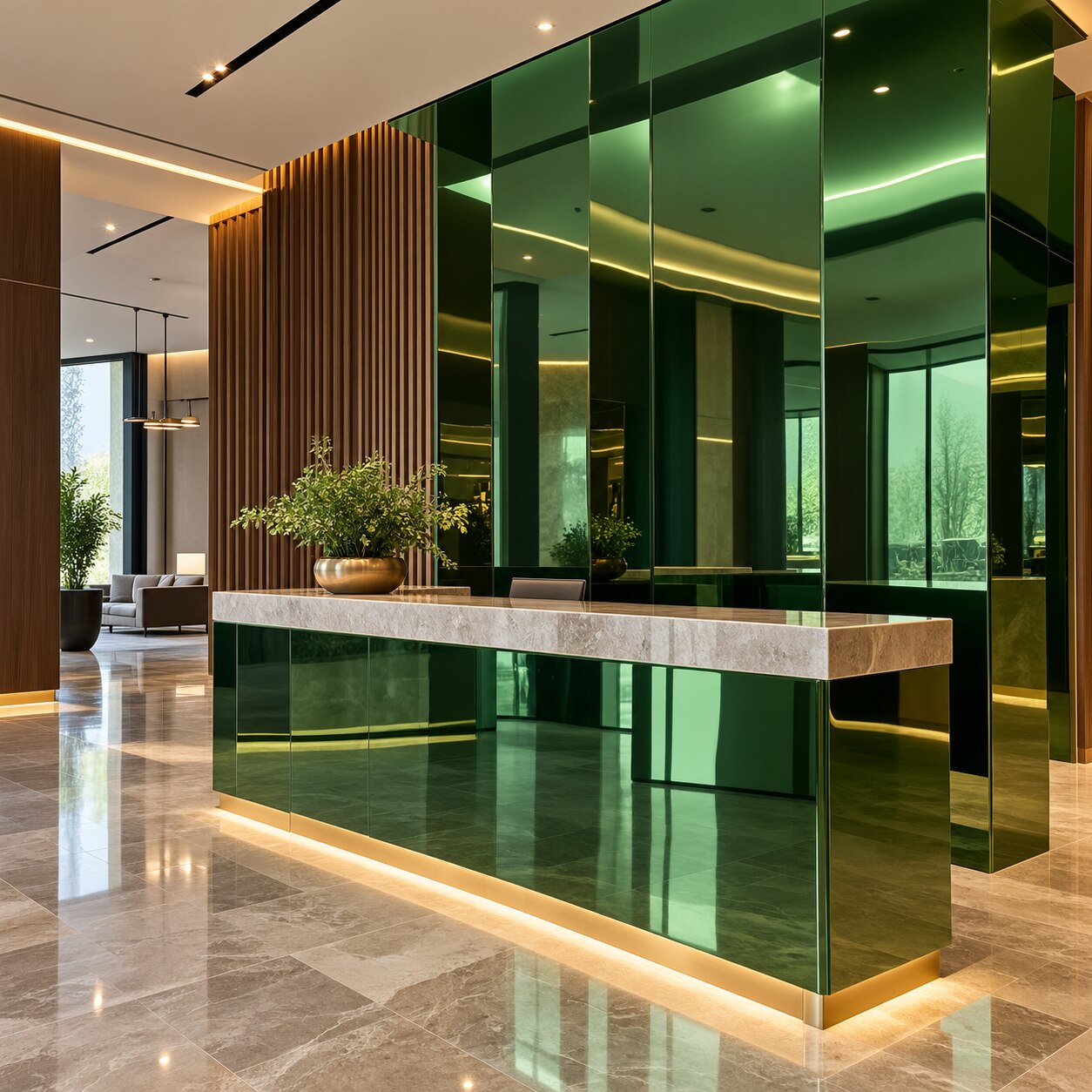
Green mirror stainless steel is a strong design choice for protected interiors but a more demanding option for exposed Mumbai façades. Your decision depends on salt exposure, traffic, cleaning access, substrate grade, fabrication quality and whether the reflective green effect justifies the maintenance it requires.
Key takeaways
- Choose green mirror PVD when colour and reflection drive the design.
- Reserve accessible locations for panels requiring regular cleaning and inspection.
- Verify stainless grade, PVD testing records, batch details and fabrication limits.
- Use approved samples to check reflections under the project’s actual lighting.
When Green Mirror Stainless Steel Makes Sense in Mumbai
Is green mirror stainless steel worth it in Mumbai? Choose it when the green reflection is central to the design, the budget covers regular cleaning, and panels remain accessible. Green mirror PVD sheets for interiors are easier to justify because air-conditioned rooms avoid direct rain, marine salt, pollution deposits and repeated wet-dry cycles.
| Location | Exposure and maintenance risk | Decision |
|---|---|---|
| Reception, lift surround, feature wall, retail display, column or furniture cladding | Dry, air-conditioned, visible and reachable for cleaning | Strong case when the reflective identity matters |
| Semi-open entrance | Monsoon humidity, dust, hard-water marks and wet-dry cycling | Use only with drainage, cleaning access and exposure evidence |
| Coastal-facing elevation or open façade | Marine salt, pollution and rain deposits can cause tea staining or localized corrosion | Compare satin or patterned finishes unless testing matches the site |
| Canopy or horizontal panel | Water traps, dust, deposits and difficult access | Usually avoid mirror unless frequent safe cleaning is planned |
Traffic changes the calculation. A lobby feature wall can justify the finish; a high-touch lower wall, handrail zone or busy lift threshold will expose fingerprints, oily marks, scratches and reflected clutter. A dusty site makes every deposit visible, while poor drainage leaves salt and hard-water residue behind.
Choose mirror PVD when design impact outweighs lifecycle effort and the specification includes evidence for the actual exposure. Choose satin, patterned or other non-mirror finishes when the site is high-touch, poorly drained, abrasive, or difficult to clean. The cheaper panel can become the costlier choice if access equipment and repeated cleaning consume the maintenance budget.
The Design Benefits—and the Mirror-Finish Trade-Off
Green mirror stainless steel benefits extend beyond corrosion resistance: its green tint, polished reflection and visual depth can make a compact lobby, retail wall or lift surround feel brighter and more spacious. The premium appearance also gives surrounding lighting, signage and materials greater colour impact.
Green mirror stainless panels are well suited to design elements that need attention rather than constant contact:
- Feature walls and columns
- Reception desks and selected furniture faces
- Signage surrounds and display backgrounds
- Retail counters and lift interiors
The mirror finish is also its main trade-off. It records fingerprints, oily hand marks, dust, water spots and swirl marks more readily than satin or textured metal. Reflected clutter can make a busy interior look busier, while glare or reflected movement can distract users.
Large panels demand accurate fabrication and installation. Waviness, poor flatness, uneven backing and distorted fixing lines appear immediately in a mirror reflection, even when the same defects would disappear on a satin surface. Scratches, abrasive grit and visible dents are equally difficult to conceal.
Choose another finish for high-contact handrails, heavily trafficked lower wall zones or areas exposed to abrasive grit. Green mirror is also the wrong choice where glare, reflected movement or limited cleaning access would disrupt users; satin, patterned or non-mirror finishes will hide daily wear more effectively.
How Green PVD Performs Under Real Use
Green PVD stainless steel durability means resistance to normal wear and cleaning, not immunity to scratches, gouges or impact. The colour comes from a thin vacuum-deposited surface layer over polished stainless steel; it is not paint.
| Finish | Construction | Damage and repair |
|---|---|---|
| PVD stainless steel | Coated metal substrate | Deep scratches expose the substrate; ordinary polishing will not restore the coating |
| Electroplated metal | Electrically deposited metal layer | Appearance and adhesion depend on the plated system; repairs remain visible |
| Coloured glass | Coloured glass body or surface | No metal substrate, with glass-specific breakage and replacement requirements |
Set expectations by location:
- Wall cladding and columns: suitable where dust is removed routinely and panels are protected from carts, tools and rough handling.
- Lift interiors: effective for selected walls and surrounds, but luggage, trolleys and repeated contact raise the scratch risk.
- Hand-contact zones: avoid green mirror on handrails and push areas; fingerprints and oily marks appear quickly.
- Exterior façades and canopies: monsoon rain, ultraviolet exposure, pollution, salt and airborne grit create a tougher corrosion and cleaning regime.
- Wet areas: rinse away hard-water deposits and dry the surface; trapped moisture at joints or cut-outs can stain exposed substrate.
Dust abrasion, metal-on-metal impact and aggressive scrubbing damage the mirror even when the coating resists routine wear. Cutting, drilling or folding exposes uncoated edges and substrate areas.
Use clean water or mild detergent with a soft cloth or non-abrasive pad, then rinse and dry. Exclude steel wool, abrasive powder, bleach, hypochlorite and hydrochloric-acid cleaners.
What to Verify About Grade, Testing and Fabrication
Approve green mirror PVD sheets only after separating substrate corrosion resistance from green PVD stainless steel durability. Stainless steel that resists corrosion does not automatically provide colour adhesion, abrasion resistance or scratch performance.
Ask the supplier for these documents and results:
- Substrate grade, coating process, surface preparation and adhesion result
- Abrasion method, chemical-resistance result and ultraviolet exposure evidence
- Salt-spray method and duration, including the failure criterion
- Test substrate, pretreatment and whether cut edges were tested
ASTM B117 is a comparative laboratory test, not a Mumbai service-life promise. Its salt-spray hours do not reproduce monsoon wet-dry cycles, UV, pollution, deposits, crevices or maintenance.
| Grade | Site condition | Decision |
|---|---|---|
| 304 | Sheltered interior with controlled humidity | Usually suitable, subject to fabrication and cleaning |
| 304 | Coastal, salt-sprayed or difficult-to-clean exterior | Do not approve automatically; compare 316 or 316L |
| 316/316L | High chloride exposure or persistent wetting | Obtain a written, site-specific recommendation |
Require the recommendation in writing for the actual location. Detail continuous drainage, deburred cut-outs, sealed joints, isolation from dissimilar metals and no water-trapping crevices; trapped chloride-laden water can defeat a sound specification.
Ask NIXON STEELIUM LLP for an approved physical sample and project-specific evidence, but keep grade, testing and fabrication requirements in your specification rather than treating the supplier’s sample as proof of performance.
Related products
 | PVD Coated Mirror Stainless Steel Sheets Specification Coating Type No additional coating (colored by vacuum deposition) Hardness 200 HB Corrosion Resistant Yes, high resistance to corrosion... View product → |
 | PVD Coated Mirror Stainless Steel Sheets PVD Coated Mirror Coloured Stainless Sheet Specification Steel Type Stainless Steel Steel Product Type Steel Sheets Grade 304 PVD Coated Mirror Coloured Stainless Sheet Trade Information... View product → |
The Approval and Maintenance Rules That Protect the Investment
Approve green mirror only when the design benefit pays for its maintenance. That is the practical answer to “is green mirror stainless steel worth it in Mumbai?” Require a signed-off physical sample, not a digital image, because viewing angle, polishing condition and production batch change the appearance.
Record the approved sample’s shade, reflectivity, surface grade, thickness, flatness and acceptable variation under the project’s actual lighting. The approval file must also state when protective film comes off, which lighting is used for inspection, and whether damaged panels are repaired or replaced.
Check warranty exclusions for scratches, cleaning chemicals, salt exposure, cut edges and installation damage.
Set the cleaning plan before installation:
- Spot-clean fingerprints and oily marks on high-touch areas daily or as traffic demands.
- Clean dust and hard-water marks with clean water or mild detergent, a soft cloth or non-abrasive pad; rinse and dry.
- Inspect exterior panels after each monsoon period for tea staining, deposits and water traps.
- Ban steel wool, abrasive powder, bleach, hypochlorite and hydrochloric-acid cleaners.
| Option | Approval case | Better alternative |
|---|---|---|
| Green mirror | Feature wall, controlled exposure, reliable cleaning access | Use when reflection is central to the design |
| Satin or patterned | Dust, glare, high contact or limited maintenance access | Choose for forgiving daily performance |
The green mirror stainless steel benefits justify the lifecycle effort when exposure is controlled and test evidence matches installation. Choose a more forgiving finish when upkeep, glare or physical abuse dominates.
Frequently asked questions
When does green mirror stainless steel make sense for Mumbai projects?
It suits projects where the green reflection is central to the design, panels remain accessible, and the budget allows regular cleaning. Interior panels in air-conditioned rooms face less direct rain, marine salt, pollution and wet-dry cycling than exposed façades.
What are the main green mirror stainless steel benefits?
Green mirror stainless steel adds colour, depth and reflected light without using painted sheet. It works especially well for feature walls, columns, lift surrounds, counters and other interior surfaces where the finish remains visible.
How durable is green PVD stainless steel under real use?
Green PVD stainless steel resists normal interior wear when you specify a suitable grade, protect the surface during fabrication and clean it with non-abrasive products. Scratches, fingerprints, harsh chemicals and poor handling still damage the visible mirror finish.
What should you verify before ordering green mirror stainless panels?
Check the stainless steel grade, sheet thickness, PVD documentation, colour consistency, surface-protection film, testing records, batch details and fabrication limits. Approve a full-size sample under the project’s actual lighting before production.
How should green mirror stainless steel be maintained in Mumbai?
Keep panels accessible for routine cleaning, remove dust and pollution deposits with a soft cloth, and avoid abrasive pads, chlorine-based cleaners and harsh chemicals. Confirm the cleaning method with the fabricator before handover.
Keywords