A vertical embossed pattern is not just a finish choice: its pitch, depth, direction, reflection and joint layout determine whether a commercial wall looks taller, calmer and coordinated or visibly misaligned. By the end, you will be able to choose the right application, write a fabrication-ready specification and plan installation and maintenance for Mumbai conditions.
Key takeaways
- Use vertical ribs to make walls feel taller and guide visual movement.
- Match the sheet to wall impact, moisture, cleaning and fire requirements.
- Specify grade, line direction, finish and an approved visual sample.
- Plan joints, corners and protective film before installation begins.
What the vertical-line pattern changes in a commercial interior
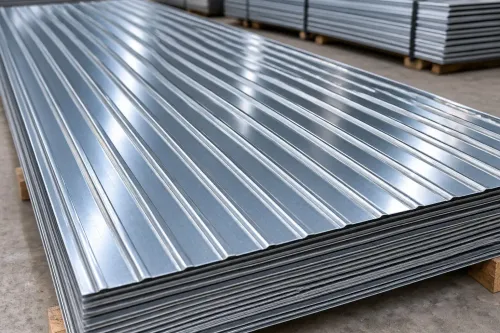
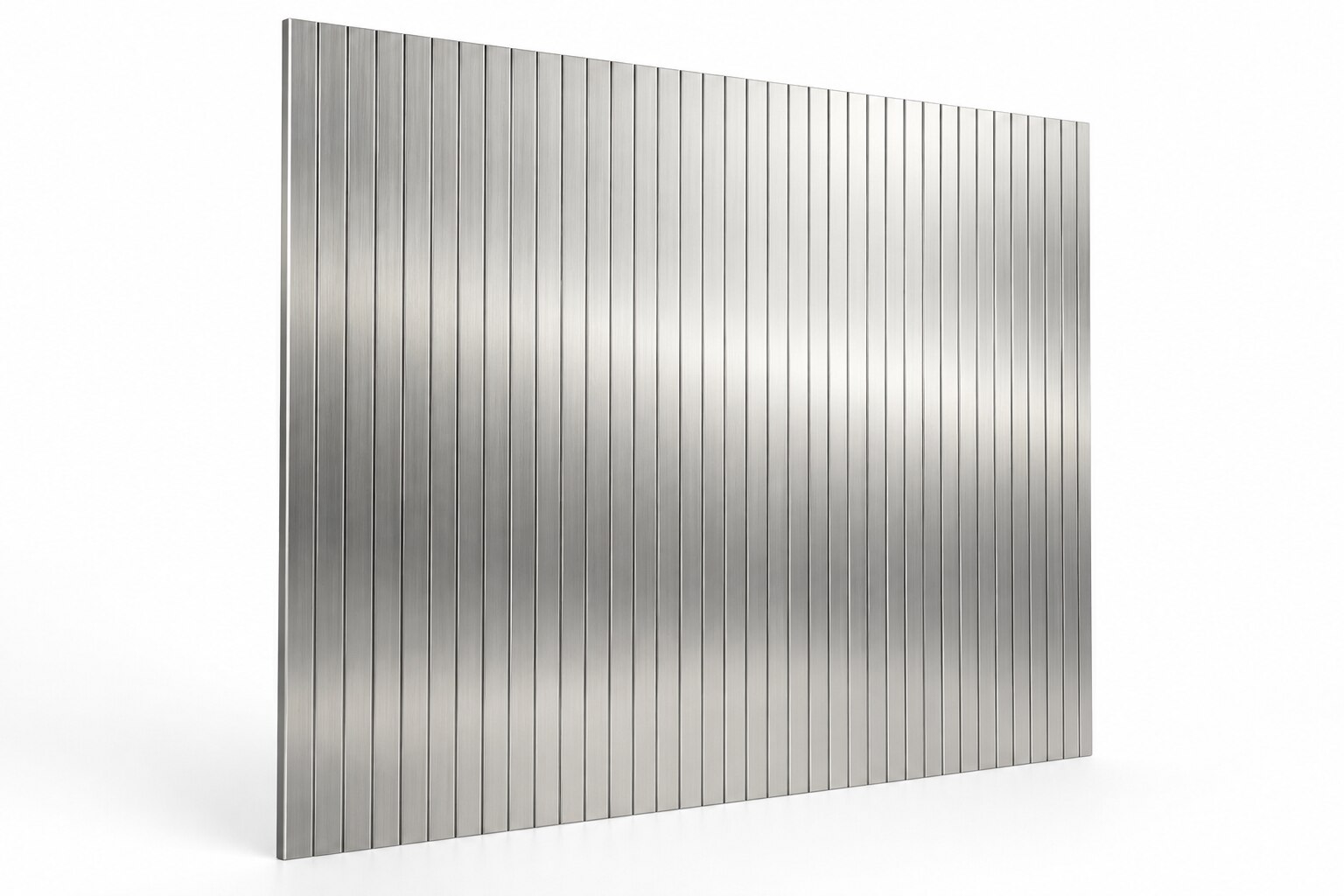
A vertical-line stainless surface looks like a field of parallel raised ribs or recessed grooves, not a flat sheet covered with printed stripes. On vertical line stainless steel sheets in Mumbai, the lines catch grazing light in alternating bright and shaded bands, making a wall appear taller and directing the eye upward.
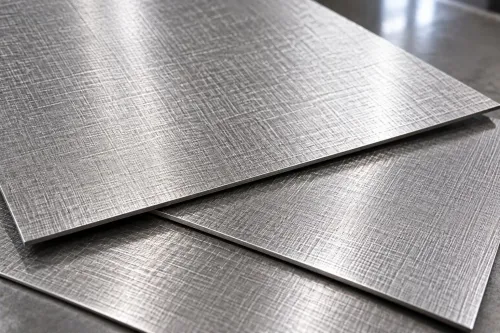
Define the pattern before approving the material. “Vertical” describes orientation, not appearance: two sheets can both run vertically while differing sharply in pitch, depth, width, and repeat. Embossing changes the sheet profile and reflection; it is not the same as a flat No. 4 brushed finish.
Specify these pattern details in the drawing or sample approval:
- Line pitch: the centre-to-centre spacing between adjacent ribs or grooves.
- Profile depth: the height of a raised line or depth of a recessed line.
- Line width and shape: sharp, rounded, narrow, broad, continuous, or broken.
- Repeat direction: lines running along the full 8 × 4 ft sheet, or a defined modular pattern.
- Orientation arrow: mark “top” and the vertical line direction on every elevation and panel layout.
The result suits lift surrounds, reception backdrops, column faces, retail feature walls, and cabinet panels. Closely spaced vertical texture metal sheets create a finer, more formal rhythm; wider lines make the cladding read bolder and can reveal waviness more readily. Rotating one panel 90 degrees creates an immediate mismatch under spotlights.
Choose the right application and supporting assembly
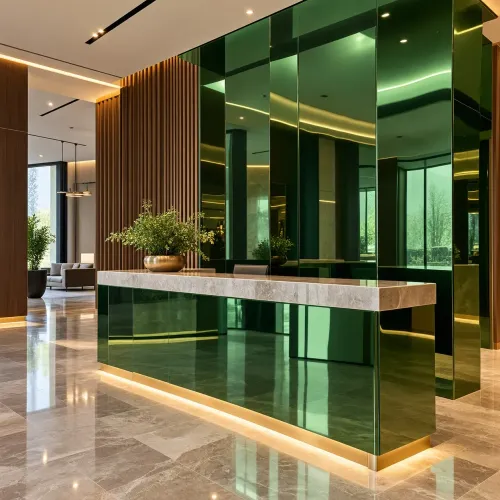
Use vertical line embossed ss sheets where the pattern can control sightlines: lift surrounds, reception backdrops, column cladding, retail feature walls, hotel corridors, restaurant interiors and signage backgrounds. Vertical ribs make a wall feel taller, while uninterrupted lines draw attention toward the ceiling rather than across the room.
| Application | Recommended construction | Why it fits |
|---|---|---|
| Wall cladding | Rigid, continuously supported substrate with adhesive or concealed mechanical fixing | Prevents oil-canning, waviness and distorted lines across large areas |
| Lift surround or column | Folded-edge cassette or framed panel | Creates accurate corners and protects exposed sheet edges |
| Reception, retail or restaurant feature | Separate fabricated panels with controlled joints | Makes replacement, alignment and access easier than one oversized sheet |
| Cabinet, door or furniture face | Flat backing, folded return or framed insert | Keeps the decorative face rigid during opening and handling |
| Washroom partition or signage insert | Purpose-built panel system with protected edges | Avoids relying on a thin sheet as a freestanding structural element |
| Structural or unsupported use | Do not specify the decorative sheet alone | Embossed stainless steel is a finish layer, not a substitute for a load-bearing panel |
For large stainless designer sheets, avoid intermittent adhesive spots on an uneven wall; they telegraph bumps and create shadow bands. Use a level substrate, full-area bonding or a cassette with designed stiffeners, and confirm the sheet’s line direction across every panel.
Specify the complete assembly, not only the face: base grade, thickness, backing, frame, edge treatment and fixing method. A 304/304L interior panel differs from a 316/316L assembly selected for humid or salt-exposed locations. Surface pattern and assembly must receive approval together.
Specify grade, finish, direction and visual acceptance
Put the design intent into the purchase order, not into a product name. Specify the complete assembly so the delivered linear embossed stainless steel sheets are judged against the installed appearance.
1. Name the material: stainless steel grade 304 or 304L for interior work; use 316 or 316L for exposed façades, pool areas, humid zones, or salt-laden air. Cite ASTM A240 for grade, chemistry, mechanical properties, and dimensional documentation.
2. State the sheet size, nominal thickness, quantity, and support construction. Include the substrate or cassette, continuous backing, folded edges, frame, adhesive, or mechanical fixing; intermittent adhesive spots can leave large panels wavy.
3. Define the pattern numerically: line pitch, embossing depth, repeat, and whether lines continue across the full sheet, such as an 8 × 4 ft panel. State “vertical when installed,” not merely “vertical line.”
4. Specify the visible finish separately from the grade: gloss or sheen, colour, and PVD colour if used. Cite ASTM A480/A480M for finish terminology, dimensions, tolerances, and flatness, but do not treat it as a decorative visual standard.
5. Attach an approved full-size or representative mock-up showing line direction, pitch, depth, colour, gloss, joints, and lighting. Brushed No. 4 is not an acceptable substitute; brushing creates scratches on a flatter surface, while embossing changes the profile and reflection.
6. Define acceptance: reject oil-canning, waviness, distorted repeats, inconsistent colour, deep scratches, dents, stains, and damaged protective film. Require sample approval before production and protective film until installation is complete.
Plan joints, corners and protection before Mumbai installation
Begin with a signed elevation drawing, not a box of sheets. Mark every panel’s line direction with an arrow, joint position, corner return and visible face; “vertical” alone will not prevent a sheet being rotated 90 degrees and creating a glaring mismatch under Mumbai’s changing light.
1. Make the substrate flat, rigid, dry and continuously supported. Remove dust, oil, loose paint and high spots, then check the wall with a straightedge. Intermittent adhesive dabs can leave vertical texture metal sheets floating between support points, causing waviness and oil-canning.
2. Approve one full-size mock-up before cutting production sheets. Include the actual backing, adhesive or fasteners, joint width, folded edges, corner detail and lighting direction. Compare the repeat, embossing depth, colour and reflection across adjacent vertical line embossed SS sheets.
3. Set out panels from a fixed datum, working in the approved sequence. Keep factory edges together where the pattern repeats, and record each panel number on the elevation. Do not mix batches or rotate off-cuts into prominent sightlines.
4. Use folded returns, trims or a shadow gap at external corners instead of forcing flat sheets around a sharp edge. Coordinate lift surrounds, door frames, skirtings and switch plates before fabrication; late drilling can distort the face.
5. Keep protective film on during cutting, drilling and nearby construction, but remove it after installation and before handover. Protect exposed edges from cement slurry, welding sparks, carbon-steel dust and impact, then clean with water and mild detergent—not chlorine, acid or abrasive pads.
Compare the finish with alternatives and control long-term maintenance
Vertical-line stainless sheets are preferable when you need a durable, directional feature surface that hides fingerprints and minor scuffs better than a mirror, while making walls and columns appear taller. They suit lift surrounds, reception backdrops, retail walls and corridors where reflected light must be controlled rather than amplified.
| Finish | Prefer vertical-line stainless when | Choose the alternative when |
|---|---|---|
| Mirror | You want texture and lower glare | Maximum brightness and reflection matter |
| Hairline | You need embossed depth and stronger pattern | A flatter brushed No. 4 surface is specified |
| Perforated | You need a solid, cleanable face | Ventilation, acoustics or transparency is the purpose |
| Fluted | You want a finer, continuous linear repeat | Deep shadow, bold relief or acoustic depth is required |
| Laminate | Moisture, impact and fire performance favour metal | Low initial cost and easy colour replacement dominate |
| Painted metal | You need colour matching | Repainting or a non-metallic appearance is acceptable |
| Ceramic | Joints, washability and tile replacement suit the area | A lightweight, fabricated metal face is more practical |
Do not substitute hairline brushing for linear embossed stainless steel sheets without an approved mock-up; the flatter scratch pattern reflects light differently. Select a supplier that confirms grade separately from appearance, provides an ASTM A240 material document, matches line direction and repeat across sheets, and records sample approval.
NIXON STEELIUM LLP is worth comparing on those deliverables, not on a product name alone.
For Mumbai interiors, clean deposits with clean water and mild detergent. Avoid chlorine cleaners, hydrochloric acid, abrasive pads and carbon-steel brushes; chloride, dust and iron contamination can cause staining. Use 316/316L near salt air, pools and humid façades, and 304/304L for ordinary interiors.
Related product
 | Stainless Steel Embossed Sheets Vertical Lines Embossed SS Sheets Specification Product Name Stainless Steel Products Steel Type Stainless Steel Steel Product Type Steel Sheets Grade 304 Thickness 0.5-3.0 Millimeter... View product → |
Frequently asked questions
What does a vertical-line pattern change in a commercial interior?
Parallel ribs or grooves catch grazing light in alternating bright and shaded bands, making walls appear taller and directing the eye upward.
How do you choose the right application and supporting assembly?
Match the sheet and backing assembly to the wall location, impact exposure, moisture, cleaning demands and required installation method.
What should a specification for vertical-line stainless steel sheets include?
State the stainless grade, finish, line direction, sheet dimensions, joint layout and an approved sample for visual acceptance.
How should you plan installation in Mumbai?
Decide joint and corner details, allow for substrate movement, and keep protective film in place until nearby wet and dusty work is complete.
How does the finish compare with alternatives?
Compare its directional light effect, cleaning pattern, durability and repair requirements with flat stainless steel, printed finishes and other textured panels.
Keywords