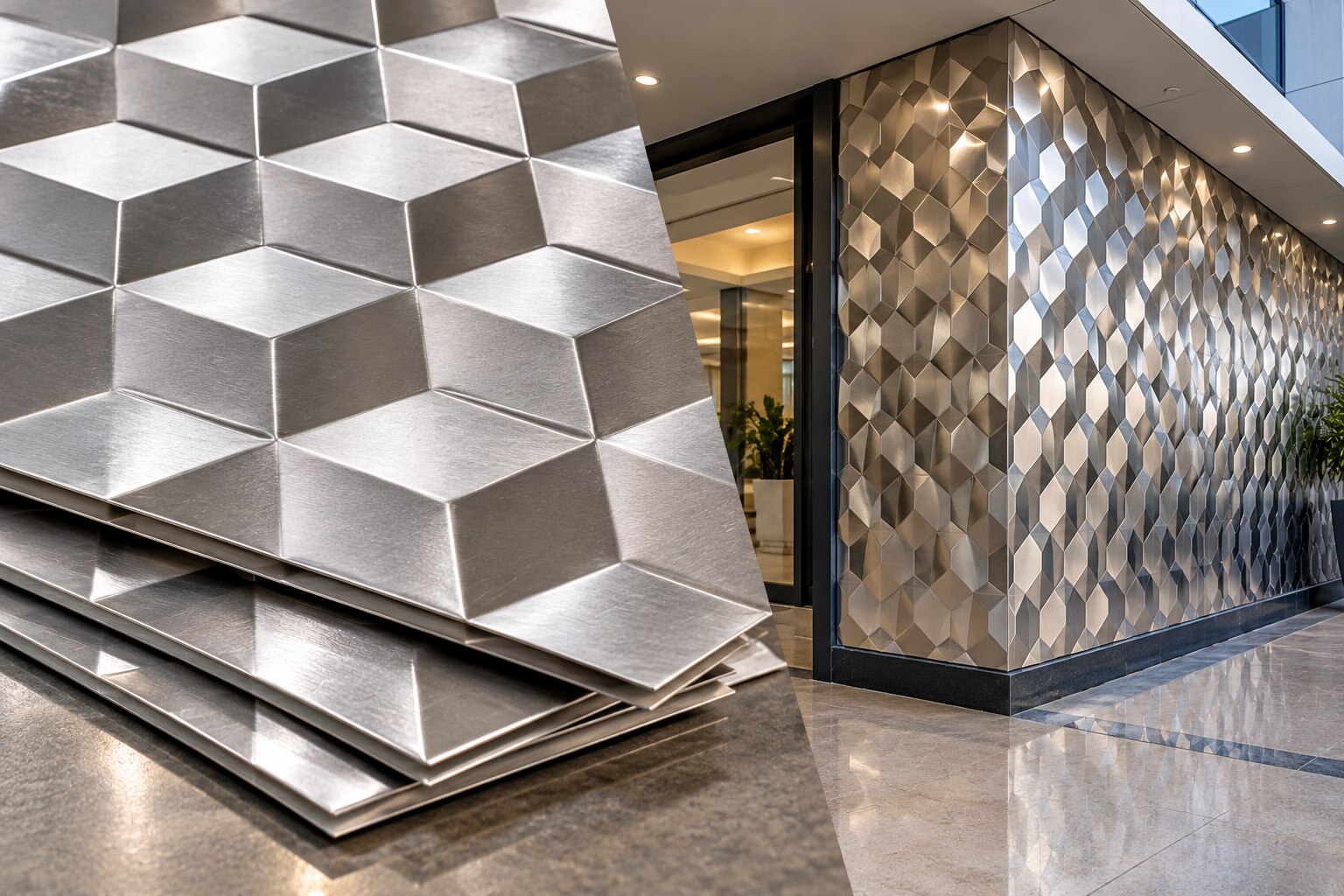
A cube-embossed stainless sheet is a decorative relief surface, not a structural wall panel. Its usefulness depends on where shifting reflections, visible joints, cleaning access, and a supporting substrate fit the design; by the end, you can match the pattern, finish, and installation method to a specific interior application.
Key takeaways
- Use cube-embossed stainless for feature walls, columns, counters, and commercial interiors.
- Specify relief depth, sheet grade, panel size, joints, substrate, and fixing method.
- Choose mirror, brushed, or PVD finishes based on lighting, fingerprints, and cleaning.
- Avoid deep cube relief where carts, impacts, moisture, or frequent disinfection dominate.
How does the three-dimensional cube pattern change a stainless steel sheet?
A repeating cube relief changes a stainless steel sheet from a flat plane into a faceted surface. Manufacturers press or roll-form the sheet between shaped dies, creating raised cube faces, angled transitions, and recessed lines; the relief projection determines how far the geometry stands proud of the original sheet.
Each angled face catches light differently, so highlights shift as you move or change the lighting angle. Close up, the recesses and edges appear strongly three-dimensional; from farther away, the pattern can read as a regular field of light and shadow. A narrow spotlight exaggerates the relief, while broad, frontal lighting flattens it.
This is the essential idea behind cube embossed metal panels explained in practical terms.
Embossing changes the finished surface, not the sheet’s structural role. A thin decorative sheet does not automatically become:
- A self-supporting wall
- A walkable floor
- A safety guard
- A load-bearing panel
Install it over a suitable substrate, frame, cassette, or backing system. The supporting construction carries the loads; the embossed stainless steel supplies the visible architectural finish.
What are three-dimensional cube stainless steel sheets used for?
The answer to what are three dimensional cube stainless steel sheets used for is straightforward: they provide a decorative, light-breaking surface for architectural interiors rather than a structural wall, floor, or load-bearing panel. The core 3d cube embossed sheet applications include:
- Feature walls
- Reception desks
- Lift interiors and lift lobbies
- Retail displays
- Hotel interiors
- Restaurant and bar fronts
- Column cladding
- Ceiling accents
- Soffits
- Furniture panels
- Cabinet fronts
- Decorative screens
- Signage backgrounds
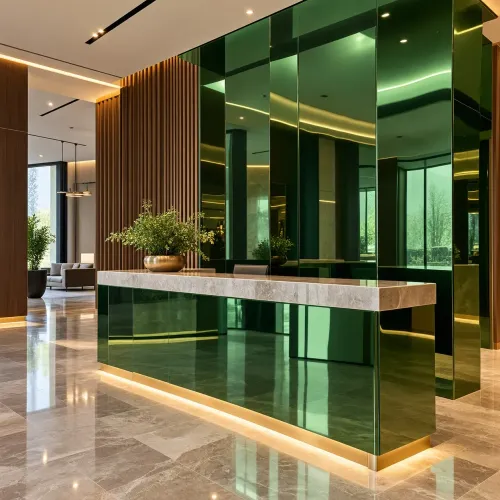
Designers use the repeated cubes to create a focal surface, divide zones within an open interior, reinforce a brand palette, or add visual depth without installing separate three-dimensional tiles. Angled faces catch light differently as people move, giving reception areas, shops, corridors, and hospitality spaces a changing surface.
Treat the sheet as a finish layer, not the supporting construction. Panels are usually installed over a substrate, cassette, frame, or backing system, which provides the required stiffness and attachment. The project specification must separately address the backing, joints, corners, access panels, and any impact, fire, hygiene, or cleanability requirements.
Where does the cube pattern work well, and where can it cause problems?
Lobbies, spacious feature walls, retail settings, hotel interiors, restaurants, and wide corridors give the cube pattern enough viewing distance to read as deliberate depth rather than visual noise. These are strong cube pattern stainless steel sheet uses because changing light creates a focal surface without adding separate wall tiles.
| Option | Works best for | Main risk or limitation |
|---|---|---|
| Cube embossing | Feature walls, lift lobbies, branded retail and hospitality interiors | Recesses collect dust, fingerprints and cleaning residue |
| Flat stainless steel | Continuous reflective fields and easy wiping | Provides less depth and hides fewer surface imperfections |
| Diamond embossing | Industrial or energetic visual schemes | Can feel busier and less architectural |
| Linen or leather grain | Subtle texture in small interiors | Adds texture without strong three-dimensional shadow |
| Vertical-line patterns | Narrow walls and taller-looking spaces | Repetition can emphasise wall distortion |
| Perforated panels | Screens, ventilation and partial separation | Openings reduce privacy and complicate cleaning |
| Three-dimensional wall tiles | Small feature zones with pronounced relief | More joints and replacement points |
| Aluminium composite panels | Lightweight, broad-area cladding | Do not provide the same metal depth or tactile finish |
| Painted or laminate finishes | Graphics, colour matching and simple repairs | Lack stainless steel’s reflective durability |
Avoid cube stainless steel sheets for interiors in narrow corridors, small rooms, low ceilings, or high-contact counters where projecting faces invite knocks. Wet areas are possible only when every recess remains reachable for drying and cleaning; otherwise water spots and residue become the feature.
How should you specify the panel system for a wall, column, or counter?
Specify the finished panel system, not just the embossed sheet. For anyone searching cube embossed metal panels explained or 3d cube embossed sheet applications, the critical decisions are fabrication, support, joints, and maintenance.
1. State the sheet thickness, permitted module sizes, and orientation of the cube repeat. Confirm the substrate is flat enough to prevent telegraphing, then define a rigid backing, cassette, or framed support rather than treating the decorative sheet as self-supporting.
2. Draw the edge treatment, corner returns, visible joint layout, and expansion allowance. Set out access panels at valves, wiring, and equipment, and identify whether adhesive, concealed clips, screws, or another mechanical fixing will carry the system.
3. Treat the embossed face as a finished-face constraint. Cutting, drilling, bending, welding, or tight-radius forming can flatten the relief, expose an uncoated edge, or break repeat registration; rotating adjacent panels can also create mismatched highlights. Approve a fabricated sample showing seams, corners, cut-outs, and fasteners before production.
4. Test the proposed assembly against the separate project requirements. The sheet alone does not establish impact resistance, fire performance, hygiene, cleanability, or service access, so obtain the backing and fixing details needed for each requirement.
Ask NIXON STEELIUM LLP for finish samples, repeat-orientation guidance, edge details, and a fabrication review when comparing suppliers; a photograph cannot show whether the proposed corner or joint will work. Record replacement-panel dimensions and access routes before approving the final shop drawing.
Related product
 | Stainless Steel Embossed Sheets Specification Product Name Stainless Steel Products Steel Type Stainless Steel Steel Product Type Steel Sheets Grade 304 Thickness 0.5-3.0 Millimeter... View product → |
Which stainless steel finish changes the appearance and upkeep of the cubes?
Mirror gives cube stainless steel sheets for interiors the strongest reflections, but it also exposes fingerprints, scratches, dust, and panel misalignment. Choose the finish by viewing production samples: photographs cannot show how gloss, colour, and apparent relief change under your actual lighting.
| Finish | Appearance | Upkeep trade-off |
|---|---|---|
| Mirror | Maximum reflection and sharp highlights | Shows fingerprints, scratches, and joint misalignment |
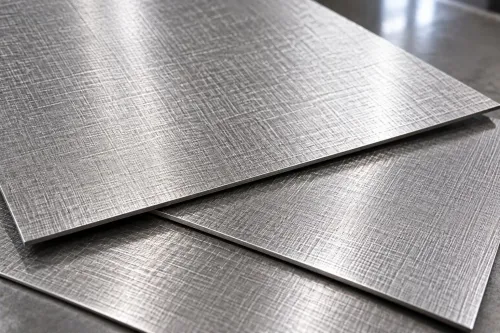
| Brushed | Softer glare with visible directional grain | Grain helps disguise handling, but clean in its direction |
| Hairline | Fine, linear grain with restrained sheen | Reveals incorrect grain alignment across panels |
| Coloured | Adds a uniform decorative colour | Confirm shade and gloss from a production sample |
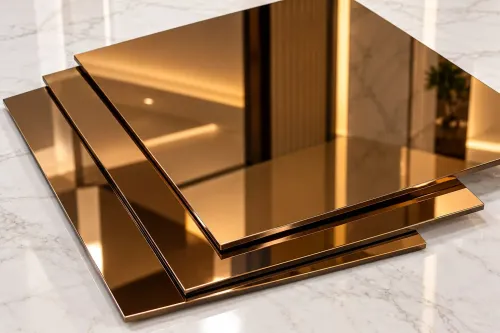
| PVD | Gold, bronze, black, blue, or champagne effect without changing embossed geometry | Protect the coating from abrasive tools and unsuitable cleaners |
Use protective film during fabrication, clean gloves during handling, nonabrasive tools, and a cleaner confirmed compatible with stainless steel and the coating. Keep carbon-steel tools and dust away; embedded iron can rust and stain the surface.
Cube pattern stainless steel sheet uses need a cleaning plan because ledges and recessed faces retain fingerprints, dust, water spots, and residue. Clean reachable surfaces with a soft cloth, not a scratch pad.
How do you decide whether cube-embossed stainless is the right choice?
Choose cube embossing when changing light, tactile depth, and a durable architectural finish matter more than a perfectly flat reflective field, uninterrupted graphics, or easy field repair. Ask what are three dimensional cube stainless steel sheets used for before approval: they suit feature surfaces, not load-bearing construction.
Cube embossed metal panels explained plainly: the decorative face still needs a substrate, cassette, frame, or backing system.
| Option | Choose cube embossing | Choose another finish |
|---|---|---|
| Visual aim | Faceted highlights and depth | Flat reflection or continuous graphics |
| Maintenance | Accessible surfaces and accepted shadowing | Smooth, easily wiped surfaces |
| Construction | Panelized layouts with visible joints | Uninterrupted fields or simple repairs |
- Match grade to exposure: 304 suits many interiors; consider 316 or 316L for chloride-rich coastal, pool, or wet locations.
- Confirm cleaning access, drainage, lighting angle, joint visibility, and a corner strategy before approval.
- Specify replacement panels and distinguish the decorative face from the supporting wall system; the latter carries structural and access requirements.
Frequently asked questions
What are three-dimensional cube stainless steel sheets used for?
They are used for feature walls, columns, reception counters, bar fronts, retail displays, elevator surrounds, hospitality interiors, and selected commercial or architectural cladding.
Where does the cube pattern work well, and where can it cause problems?
The pattern works well where you want visual depth and changing reflections. Deep relief can cause problems in high-impact areas, narrow passages, wet zones, and surfaces requiring frequent cleaning.
How should you specify a cube stainless steel panel system?
Specify stainless steel grade, sheet thickness, cube relief projection, panel dimensions, edge returns, joint width, substrate, fixing method, access requirements, and installation tolerances.
Which stainless steel finish changes the appearance and upkeep of the cubes?
Mirror finishes produce sharp reflections, brushed finishes soften the geometry, and PVD coatings add colour and surface variation. Each finish changes how clearly fingerprints, scratches, and cleaning marks appear.
How do you decide whether cube-embossed stainless steel is suitable?
Choose it when faceted texture supports the design and the site can protect the relief from impacts. Select a flatter or smoother finish when hygiene, access, or abrasion resistance is the priority.
Keywords