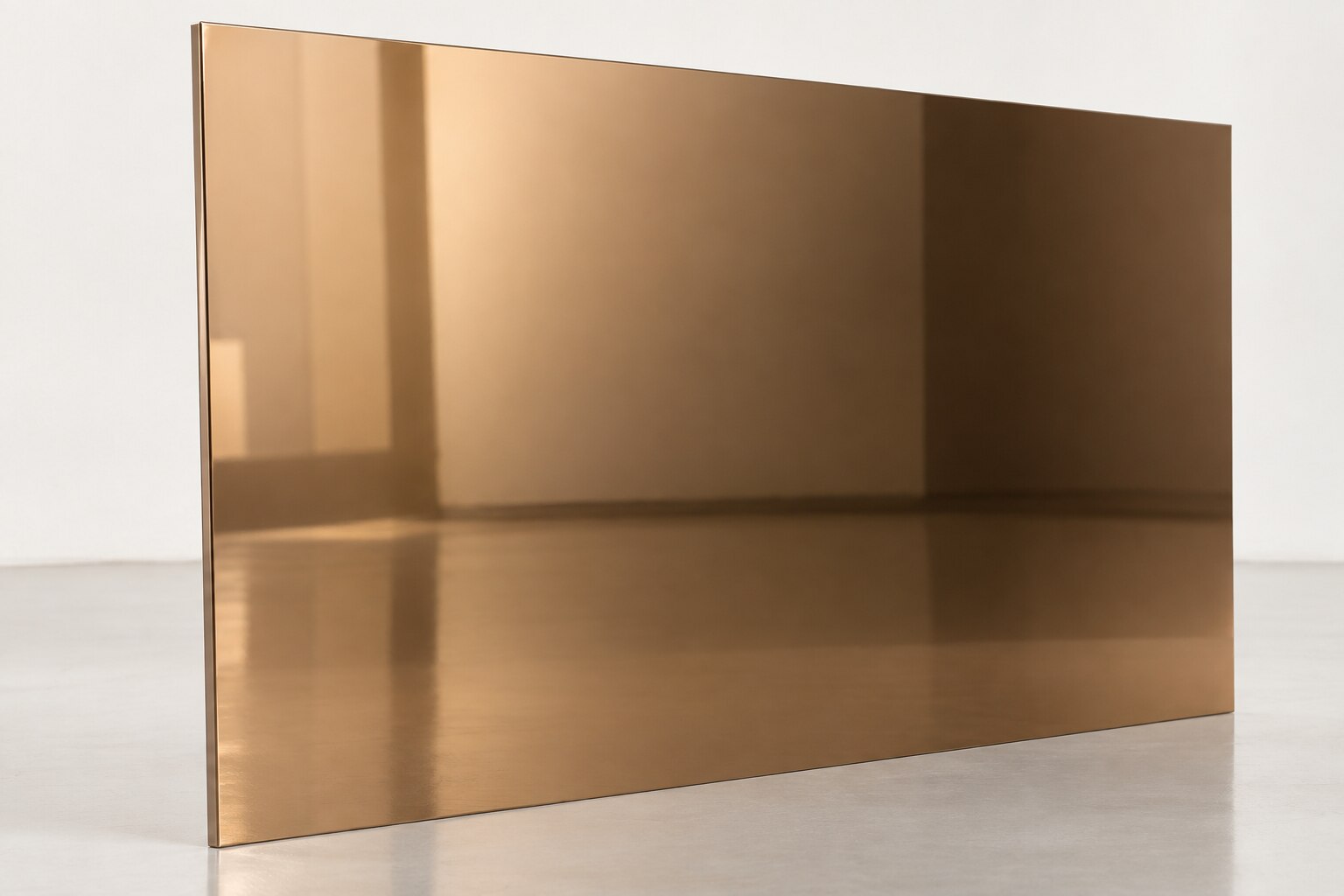
Bronze mirror SS PVD sheets can work well in Mumbai, but the correct choice depends on chloride exposure, water management, traffic, handling and cleaning rather than colour alone. By the end, you will be able to classify your application, compare 304 with 316 or 316L, and write a specification that controls finish, fabrication and maintenance risks.
Key takeaways
- Use bronze mirror PVD sheets indoors or behind reliable weather protection.
- Specify 316 or 316L where salt spray, condensation or chemical exposure is expected.
- Protect mirror finishes from scratches during transport, installation and cleaning.
- Use sealed joints and drainage details in wet or semi-exposed locations.
Where bronze mirror PVD sheets fit Mumbai’s exposure conditions
Bronze mirror PVD sheets can suit Mumbai projects, but indoor and sheltered locations are the safest applications. Exposure, drainage and maintenance—not the bronze colour—determine whether the finish remains acceptable.
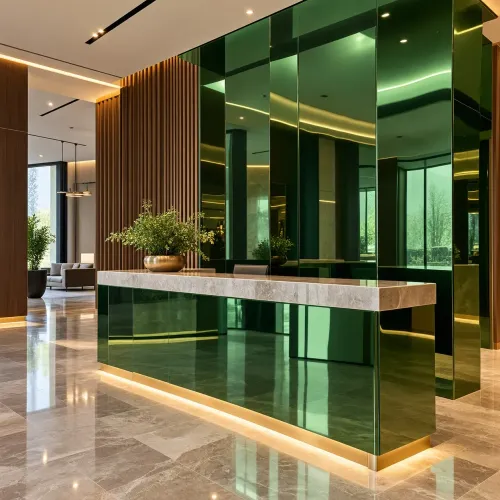
- Indoor: Use them for sheltered interior walls, lift surrounds, reception counters, ceilings and protected entrance features. These locations avoid direct salt spray and repeated wetting.
- Semi-outdoor: Recessed entrances, balcony soffits and covered columns need drained joints, protection from wind-driven rain, and a defined plan for removing dust and salt.
- Fully exposed: Treat façades, parapets, balcony edges and horizontal ledges as higher-risk applications. Specify them only after reviewing the substrate, fixings, joints and cleaning access.
Coastal exposure is not limited to the shoreline. Airborne sea salt, traffic deposits, monsoon rain and nearby industrial contamination can affect bronze mirror SS PVD sheets in Mumbai several kilometres inland.
Standing water, leaking joints and salt deposits that remain wet create more risk than a clean, well-drained vertical panel. Horizontal ledges also receive less natural wash-down and collect grime, so they need deliberate drainage and more frequent cleaning.
The colour does not determine corrosion performance. The stainless substrate, installation detailing, washing frequency and exposure do. Bronze mirror PVD sheets are therefore most defensible where water drains quickly, joints do not trap contaminants, and maintenance staff can rinse away salt and dust.
Is 304 enough, or should you specify 316 or 316L?
For exposed Mumbai exterior work, compare 316 or 316L before accepting 304. 304 can be reasonable for dry interiors and sheltered areas; 316 and 316L are generally safer for chloride exposure because molybdenum improves resistance to chloride pitting.
| Grade | Sensible comparison | Main limitation |
|---|---|---|
| 304 | Dry interiors, recessed features and sheltered panels | Less chloride-pitting resistance |
| 316 | Exposed façades and coastal exterior areas | Not corrosion-proof |
| 316L | Exposed work with welded or fabricated details | Not corrosion-proof; low carbon does not replace good detailing |
Wet salt deposits, oxygen-starved crevices, contaminated cut edges and poor drainage can attack even 316 or 316L. Before selecting a bronze mirror stainless sheet, record:
- Distance from the sea
- Façade direction and wind-driven rain
- Natural rain wash-down
- Nearby roads and traffic deposits
- Nearby industrial sources
PVD is a thin decorative hard coating, not a corrosion barrier. It cannot repair an unsuitable alloy, contaminated substrate, unpassivated cut edge or crevice.
For ss pvd sheets for projects, specify the stainless grade, thickness, PVD colour designation, coating-side orientation, mirror-finish requirement, protective film, allowable defect limits and an approved physical sample. A nominal No. 8 mirror designation under ASTM A480 does not fully define reflectivity, waviness, colour or viewing-angle variation.
Approve the sample under the project’s actual lighting before production.
How will the finish behave on doors, counters, walls and wet areas?
Lift doors, reception counters, wall cladding, columns and retail displays suit bronze mirror PVD sheets when fingerprints, regular cleaning and eventual panel replacement are acceptable. PVD improves wear resistance over an uncoated decorative surface; it does not make a mirror face scratch-proof or field-refinishable.
| Location | Suitability | Main condition |
|---|---|---|
| Lift surrounds and doors | Good for selected interiors | Accept fingerprints, luggage marks and replaceable panels |
| Reception counters and retail displays | Good | Protect edges and plan routine cleaning |
| Wall cladding and columns | Good above contact height | Avoid low-level public impact zones |
| Ceilings | Good | Prevent joints trapping dust or condensation |
| Curved panels | Conditional | Use controlled forming and approve a finish sample; bending can alter visual uniformity |
| Facades and balconies | Conditional | Complete a corrosion, drainage and fixing review before approval |
Bronze PVD sheets in Mumbai are a poor choice for low-level public walls, luggage-contact zones and heavily trafficked lift interiors unless cosmetic wear is acceptable and damaged panels can be replaced.
Kitchens suit the material in splash zones when water drains and cleaners are controlled. Washrooms need the same discipline: standing water, leaking fittings, cement slurry, grout residue and chloride-bearing products create avoidable damage.
Treat exposed façades and balconies as engineering decisions, not automatic approvals. Drained joints and washable details matter more than colour; poor fixing or trapped salt can damage the substrate beneath the coating.
How does bronze PVD compare with glass, aluminium, laminate and paint?
Choose bronze mirror PVD sheets over another bronze-looking finish only after comparing damage, weight, optics, moisture and replacement.
| Option | Compare before choosing | Main drawback |
|---|---|---|
| Bronze-tinted glass | Higher breakage risk and weight; vulnerable edges; strong reflectivity | Stainless avoids glass breakage, but shows dents, scratches and installation waviness |
| Bronze anodised aluminium | Lighter and easier to form; match colour and corrosion limits for both systems | Lower mass does not remove forming or finish-variation risks |
| Laminate | Easier impact replacement and repair; check edge swelling and moisture tolerance | Damaged edges and wet cores can deteriorate quickly |
| Painted steel | Check peeling, edge damage and whether field touch-up will match | Touch-up remains visible and the film can peel |
| Ordinary mirror stainless steel | Compare bronze colour against neutral reflectivity and glare | It lacks the intended bronze appearance |
PVD colour comes from deposition, not paint, so it does not peel like conventional paint. Exposed edges, burrs, scratches and damaged substrate remain visible and are difficult to repair invisibly.
Bronze colour can vary by batch, viewing angle, lighting, sheet direction and polishing route. Approve a representative full-size mock-up for a large elevation, not a small catalogue chip.
A mirror face also exposes fingerprints, Mumbai dust, swirl marks, glare, dents and lighting that reveals waviness or poor installation. Specify bronze mirror stainless sheet only when the cleaning burden and replacement plan are acceptable.
What should your Mumbai specification, installation and cleaning plan require?
Treat bronze mirror SS PVD sheets for projects as a controlled finish, not a standard sheet-metal purchase. Your Mumbai specification should require:
1. Approve a physical sample before ordering, define allowable colour and surface variation, record coating-side orientation and mirror requirements, specify protective film, and retain one controlled production batch for each large elevation. Inspect every face before installation; reject scratches, scuffs, waviness and coating defects.
2. Require fabrication controls for bronze pvd sheets in Mumbai: keep abrasive swarf, grinding dust and welding sparks away from the face; remove heat tint, embedded iron, burrs and rough edges; and use a cleaning or passivation procedure compatible with the coating.
ASTM A967 covers chemical passivation for stainless components, not decorative repair of damaged PVD. Complete approved treatment on uncoated fabricated parts before installing decorative face material.
3. Detail drained joints, eliminate horizontal dirt shelves, isolate incompatible metals, and close or ventilate crevices. Prevent cement slurry and grout from drying on the face. These details matter more than the colour label for bronze mirror pvd sheets in Mumbai.
4. Rinse salt and dust with clean water, wash with mild detergent and a soft non-abrasive cloth in the sheet direction, then rinse and dry thoroughly. Trial the method in an inconspicuous area. Ban hydrochloric or muriatic acid, bleach residue, chloride-bearing cleaners, steel wool and carbon-steel tools.
NIXON STEELIUM LLP can help coordinate the finish sample, fabrication sequence and project-specific panel specification; approve the final detail against site exposure and testing.
Related product
 | PVD Coated Mirror Stainless Steel Sheets Specification Product Name Stainless Steel Products Steel Type Stainless Steel Steel Product Type Steel Sheets Grade 304 Thickness 0.5-3.0 Millimeter... View product → |
Frequently asked questions
Are bronze mirror PVD sheets suitable for Mumbai’s coastal climate?
Yes, for indoor and sheltered areas with controlled moisture, drainage and regular cleaning. Fully exposed locations require stricter material and detailing decisions.
Is 304 stainless steel enough for Mumbai projects?
304 can suit dry interior applications. Specify 316 or 316L when the sheet faces salt-laden air, persistent condensation, wet areas or chemical exposure.
How does bronze mirror PVD compare with glass, aluminium, laminate and paint?
Bronze mirror PVD stainless steel offers a durable metallic surface, but glass can provide greater visual depth, aluminium lower weight, laminate easier replacement and paint broader colour flexibility.
What should installation and cleaning plans require?
Require protected handling, compatible fixings, sealed joints, drainage where needed, non-abrasive cleaning and removal of protective film after surrounding work is complete.
Keywords