A factory-grade cube panel is not defined by its appearance alone: the repeat pitch, emboss depth, base-metal thickness, surface finish, and forming sequence all affect whether adjacent sheets match and whether the panel survives fabrication. By the end, you will know how to trace the production stages, compare genuine embossed sheets with printed effects, and write a purchase specification that a supplier can inspect against.
Key takeaways
- Specify the stainless grade and sheet thickness before approving the cube pattern.
- Use matched tooling to control cube depth, alignment, and springback.
- Apply polishing, coloring, or PVD coating after forming and surface inspection.
- Require a factory inspection pack with dimensions, finish, grade, and batch records.
How the stainless sheet is prepared before embossing
The starting sheet determines whether the cube pattern forms cleanly or exposes cracks, uneven facets, and excessive springback. In how 3D cube SS designer sheets are made, the pattern is treated as a forming operation, not a substitute for specifying the stainless grade.
1. Select the grade and gauge. Identify 304/304L, 316/316L, or 430, then state the incoming flat-sheet thickness, such as 0.5 to 3.0 mm. ASTM A240/A240M is the usual material reference for flat-rolled stainless sheet and strip.
2. Inspect the coil or panel for pits, scratches, edge cracks, weld joints, waviness, and inconsistent thickness. Reject defects that will become prominent on cube peaks or transition radii.
3. Clean the surface with a compatible degreaser and remove oil, dirt, scale, and loose particles. Contamination can mark the face and interfere with later polishing or coating.
4. Level the sheet with a roller leveler, controlling crossbow, coil set, and flatness without gouging the surface. A distorted blank will register poorly and produce unequal cube depths.
5. Confirm the preparation record before embossing: grade, heat or batch number, measured gauge, surface finish, sheet dimensions, and rolling direction. This is a core control in SS designer sheets manufacturing.
The stated thickness normally refers to the unembossed base metal before cold forming, not the height over the finished cube. Embossing redistributes material and creates local thickness and strain variation, while the back may show pressure marks or a reverse pattern.
Specify base-metal thickness and overall maximum thickness separately, and approve a cross-section or physical sample.
How matched tooling transfers the cube pattern
Matched male-and-female patterned rolls transfer 3D cube embossed sheets during continuous production. The upper roll carries the raised cube geometry; the lower roll provides the matching recess. As stainless strip passes through the nip, controlled pressure forces metal into the cavities rather than cutting or stretching it like a machining operation.
A platen or hydraulic press uses corresponding male-and-female dies for discrete panels. It suits fixed-length sheets and custom panel sizes, but it does not match the speed or continuous repeat registration of roll embossing. The die closes in a measured stroke, then opens before the panel is repositioned.
The production controls that protect the pattern and the stainless include:
- Roll or die alignment, which keeps opposing facets registered instead of producing doubled edges or uneven cubes.
- Roll gap or press force, which sets penetration and emboss depth without excessive local thinning.
- Line tension and feed speed for roll production, which prevent pitch stretch, buckling, and repeat drift.
- Lubrication and radiused tool transitions, which reduce tearing and cracking at cube peaks and valleys.
- A controlled reduction, which forms the pattern without forcing too much material into one narrow zone.
- Tool temperature and surface condition, which limit pickup marks and friction scratches.
Cold forming work-hardens the patterned areas, so cube embossed stainless steel sheets can spring back and lose ductility during later bending or drilling. Validate those operations on the actual grade, thickness, and pattern; a flat-sheet trial does not prove the embossed panel will behave safely.
What embossing changes in the finished panel
Embossing changes the panel’s geometry, not simply its thickness. Metal is redistributed around the cube’s peaks, valleys, and transition radii, so local thickness and strain vary; the unsupported reverse face may show pressure marks or a mirrored pattern.
Weight per square metre changes little because material is displaced rather than added, while the increased profile height improves stiffness. The panel can still develop bow, twist, or edge wave.
Cold work reduces forming ductility and increases springback. Do not assume a flat stainless sheet’s bend radius remains safe after embossing. Validate bending, shearing, laser cutting, and drilling on the actual grade and pattern: expect burrs, heat tint, cracked facets, distorted holes, or exposed uncoated edges.
Embossed steel sheets for factories should be fabricated only after these operations pass a sample test.
Request these measurements on the approval sample and production report:
- Base-metal thickness measured in a flat valley, plus maximum finished height from the agreed back-face datum
- Cube pitch, emboss depth, facet profile or angle, and usable edge margin
- Panel length, width, diagonal, and orientation mark for pattern registration
- Overall bow, twist, and edge wave measured against a defined datum, separately from pattern high-low variation
- Hole position, cut-edge condition, burr limit, and joint mismatch after fabrication
- Mass per square metre and sample bend, cut, and drill results
For cube embossed stainless steel sheets, define whether “thickness” means base thickness, maximum overall thickness, or both. Without that definition, two panels can meet the same nominal specification yet fit differently.
When polishing, coloring, and PVD coating are applied
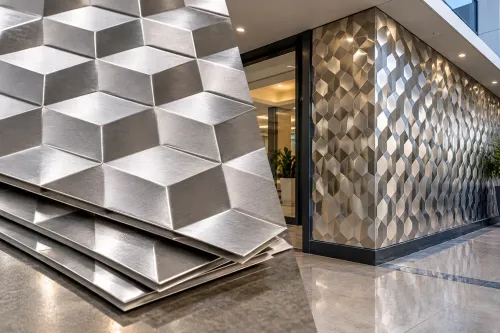
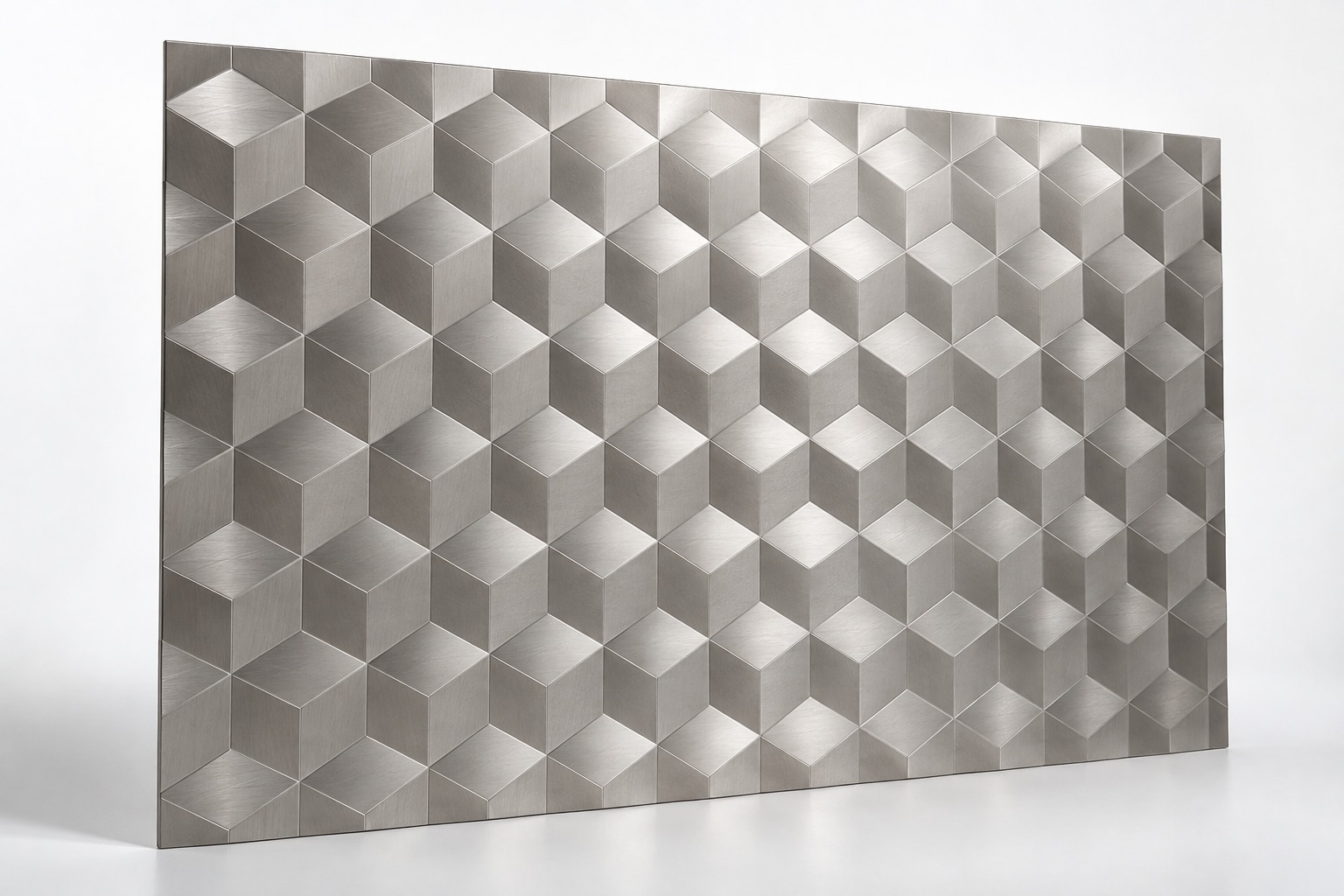
A mechanically formed cube has raised and recessed facets with measurable pitch and depth; printing, etching, laser marking, or a graphic film only creates a visual pattern on a flat surface. In 3D cube embossed sheets manufacturing, the relief must remain visible by touch and in cross-section, including after polishing.
1. Establish the base finish on the stainless sheet or on the formed panel, depending on the approved route. A No. 8-type mirror finish needs polishing and buffing, but cube facets can reflect light differently from the flat areas because of their angle and waviness.
2. Emboss the sheet before PVD coating when the design includes sharp peaks, deep recesses, or later bending. Forming a coated sheet can stretch and crack the thin decorative layer at peaks and radii. Some suppliers coat stock before limited forming, so require the actual sequence rather than assuming it.
3. Clean and activate the polished, embossed surface before coloring or PVD deposition. Oil, abrasive residue, and fingerprints reduce adhesion; PVD is a thin decorative coating, not a replacement for stainless steel’s corrosion resistance.
4. Protect finished faces with suitable film and separators during trimming, drilling, and handling. Scratches on a mirror facet are difficult to blend without changing its reflectivity.
5. Complete welding before decorative finishing whenever possible. Heat can discolor the stainless and damage the coating; if welding follows coating, remove the coating at the joint, conceal the seam, then clean and passivate the area using practices in ASTM A380/A380M.
Request bend, scratch, adhesion, and cleaning samples before approving production. Post-fabrication cleaning must avoid abrasive pads that flatten or haze the cube facets.
The factory specification and inspection pack to require
Require a signed approval pack before production; “cube embossed” and a colour name do not control fit, appearance, or replacement. It should define how 3D cube SS designer sheets are made for your project, including the measurement datum and acceptance method.
1. Record substrate grade, base-metal thickness, panel size, and whether thickness means flat substrate, maximum formed thickness, or both. State the pattern name, measured pitch, emboss depth, facet angle or cross-section, and usable edge margin.
2. Mark the pattern orientation on the drawing: installation direction, coating side, joint edge, and any rotation that is unacceptable. Set tolerances for pitch, depth, panel length and width, edge margin, bow, twist, edge wave, and joint mismatch.
3. Specify the finish sequence: embossing, polishing or brushing, cleaning, PVD coating, inspection, and film application. Require the actual sequence because forming after PVD can damage coating at peaks and bends.
4. Define exposed-edge treatment—cut edge, folded return, welded-and-ground edge, or capped edge—and state which edges remain visible.
5. Approve a full-size or representative sample with bend, scratch, coating-adhesion, colour, and cleaning tests. Inspect the reverse face for pressure marks and confirm the agreed facet profile.
6. Name the protective-film type and removal stage, then specify corner protection, separators, pallet support, moisture protection, and package labels.
7. Register each approved panel by drawing revision, batch number, orientation mark, and replacement-panel code. Nixon Steelium LLP fits here as the manufacturer documenting these controls before releasing embossed steel sheets for factories.
Related product
 | Stainless Steel Embossed Sheets Specification Product Name Stainless Steel Products Steel Type Stainless Steel Steel Product Type Steel Sheets Grade 304 Thickness 0.5-3.0 Millimeter... View product → |
Frequently asked questions
How is stainless steel prepared before cube embossing?
The factory selects the stainless grade and thickness, checks the sheet surface, and prepares it for forming without hiding cracks or defects.
How does matched tooling transfer the 3D cube pattern?
Matched male and female tooling presses the sheet between aligned surfaces to form consistent cube facets, depth, and repeatable spacing.
What does embossing change in the finished stainless steel panel?
Embossing changes the panel’s surface geometry, reflectivity, stiffness, dimensions, and springback, so the formed sheet requires dimensional inspection.
When are polishing, coloring, and PVD coating applied?
Forming and surface checks come first; polishing, coloring, or PVD coating follows when the required finish is compatible with the embossed geometry.
What should a factory inspection pack contain?
Require the stainless grade, thickness, batch details, pattern dimensions, finish description, coating information, dimensional results, and inspection records.
Keywords