
Rain is only one part of the problem: salt deposits, trapped water, carbon-steel dust, heat tint and poorly planned joints create many visible failures during Mumbai’s wet season. By the end, you will be able to match the grade and finish to the exposure, specify diamond-pattern sheets accurately, prepare them for fabrication and store them without avoidable staining.
Key takeaways
- Use 304 or 304L for sheltered interiors and dry urban exteriors.
- Choose 316 or 316L where salt, chlorides or standing water reach the sheet.
- Specify grade, thickness, finish, pattern depth, tolerances and protective film before ordering.
- Store sheets dry, separated and covered; inspect edges, welds and film damage after installation.
Which stainless grade suits each Mumbai monsoon exposure?
Choose stainless grade by the contaminants and water conditions reaching the finished component, not by Mumbai rainfall alone. For stainless steel sheets for fabricators in Mumbai monsoon conditions, Grade 304 or 304L suits sheltered interiors, dry commercial areas and many urban exteriors.
| Exposure | Starting grade | Decision point |
|---|---|---|
| Sheltered interior or dry urban exterior | 304 or 304L | Suitable when water, salt and chemicals do not remain on the surface |
| Open façade, balcony or canopy | 304/304L; compare 316/316L | Wind-driven rain carries coastal salt and construction dust into joints and pattern valleys |
| Wash area or splash zone | Compare 304/304L with 316/316L | Cleaning chemicals, splash, poor drainage or standing water can justify 316 |
| Persistent chloride, stagnant salty water or industrial pollution | 316 or 316L | Molybdenum improves resistance to localised pitting |
The phrase monsoon resistant steel sheets describes a design outcome, not a grade. Neither 304 nor 316 is immune when moisture remains trapped.
Use PREN = %Cr + 3.3(%Mo) + 16(%N) to compare specified grades, but treat PREN as a comparison tool, not a service-life guarantee; surface condition, deposits, crevices, temperature and exposure chemistry still control pitting.
Ask for the exact grade designation and heat documentation. Reject vague terms such as “marine grade” or “monsoon resistant”; stainless steel sheets for fabricators need a specified alloy, finish and installation exposure.
What makes a stainless sheet monsoon resistant after installation?
A monsoon-resistant assembly needs more than a suitable alloy: use a clean surface, protected edges, compatible fasteners, open drainage and joints that do not hold water. Rain alone rarely stains well-finished stainless steel severely; coastal salt, industrial deposits and wet construction dust create the greater risk.
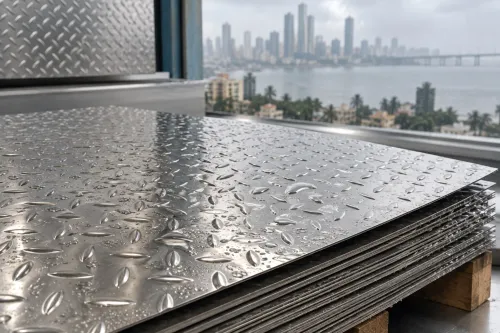
Design the installation so water can leave. Avoid blind crevices, horizontal dirt-catching ledges and dissimilar-metal contacts that trap electrolytes. Provide fall, weep holes or open drainage where the profile permits, and leave access for fresh-water washing. Diamond pattern steel sheets need extra scrutiny because valleys and pattern transitions retain water, salt and debris.
A smooth mirror finish usually collects fewer contaminants than a rough embossed surface, but scratches, embedded iron, weld heat tint and trapped deposits can still stain it. PVD-coated mirror sheets need separate handling: PVD is a decorative coating, not a substitute for a corrosion-resistant substrate.
Abrasive cleaners, grinding sparks, aggressive chemicals and later fabrication can damage the colour.
Before handover, check:
- Edges are sealed, folded or otherwise protected from standing moisture.
- Fasteners do not create dissimilar-metal contact or exposed crevices.
- Joints, returns and pattern valleys drain and remain reachable for rinsing.
- No horizontal ledge collects dust beneath the sheet.
- The cleaning plan uses fresh water and a compatible non-abrasive cleaner.
- ISO 9227 salt-spray-hour claims are not treated as proof of Mumbai service performance; the test compares coating behaviour under controlled exposure, not every architectural site.
How should you fabricate diamond-pattern stainless steel sheets?
Treat the raised diamond pattern as a dimensional feature during every cutting, drilling and bending operation. Diamond pattern steel sheets can produce inaccurate panels when fabricators measure only the nominal perimeter.
1. Identify the pattern direction before marking, then establish reference lines from the usable flat area rather than only the sheet edges. Confirm whether the stated thickness means base-metal thickness or overall thickness across the embossing. The raised pattern is not structural thickness.
2. Support the sheet continuously during shearing or laser cutting. Allow for the diamonds’ effect on support, kerf position and edge distortion, then inspect the cut edge for local deformation.
3. Drill from a stable surface, keep clamps clear of raised diamonds and check hole centres after cutting. A hole near a pattern transition can appear misplaced even when its centre was marked correctly.
4. Match bending direction and tooling clearance to the raised profile. Make a trial piece when the pattern crosses a bend, because embossing changes flatness, bend allowance, overlap width and the fit of folds, returns and trims. Never force the diamonds flat.
5. For diamond embossed stainless steel sheets in Mumbai, approve a sample or drawing showing pattern geometry, direction and tolerances before production. Stainless steel sheets for fabricators intended for floors or treads can reference ASTM A793/A793M, but that standard covers rolled floor-plate dimensional and manufacturing requirements—not decorative appearance, PVD colour uniformity or project-specific corrosion performance.
What should you specify before ordering sheets for a Mumbai job?
Put the purchase specification in writing before the sheets reach the cutting table. For stainless steel sheets for fabricators, use this sequence:
1. Define the material and geometry. State the exact grade, nominal base thickness, actual sheet length and width, pattern geometry, pattern direction, dimensional tolerances and usable flat area after edge trimming. For diamond embossed stainless steel sheets in Mumbai, specify whether thickness means base metal or overall height across the raised pattern.
2. Confirm quantity from the cutting plan, not gross sheet area. Add replacement sheets for handling damage, pattern mismatch and a failed first article; a simple wastage percentage will not cover those failures.
3. Request traceability and condition records: heat or batch number, mill test certificate, thickness measurement method, surface-finish description and inspection photographs. Ask whether the protective film covers the complete face, remains intact at the edges and has a stated removal point.
4. For PVD or mirror surfaces, record the colour, reflectivity expectation, viewing direction and permitted handling marks. ASTM A967/A967M can govern nitric- or citric-acid passivation and verification tests, but passivation will not remove heavy weld scale or correct poor drainage.
NIXON STEELIUM LLP can help align the order, finish, pattern and documentation before fabrication; treat those documents as approval records, then inspect the delivered sheets yourself.
Related products
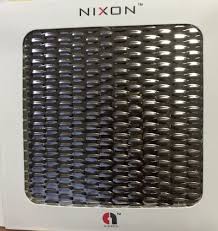 | Stainless Steel Embossed Sheets Specification Product Name Stainless Steel Products Steel Type Stainless Steel Steel Product Type Steel Sheets Grade 304 Thickness 0.5-3.0 Millimeter... View product → |
 | Stainless Steel Embossed Sheets Specification Product Name Stainless Steel Products Steel Type Stainless Steel Steel Product Type Steel Sheets Grade 304 Thickness 0.5mm-3.0mm... View product → |
How do you store, finish and inspect sheets during the monsoon?
1. Store monsoon resistant steel sheets above the floor on clean supports, away from carbon-steel racks, salt-contaminated dust, wet cardboard and leaking roofs. Cover the stack against rain but leave air movement; an airtight cover over damp sheets traps condensation.
Separate wet packaging immediately, then inspect edges, protective film and embossed pattern valleys for staining or trapped water.
2. Prevent contamination during fabrication. Use dedicated, or thoroughly cleaned, slings, brushes, clamps, worktables and grinding wheels. Carbon-steel wire brushes and grinding dust embed iron particles that later rust, creating apparent stainless corrosion. After laser cutting or welding, remove heat tint and oxide contamination using the specified cleaning, pickling, electropolishing or passivation process.
Wiping away visible colour does not restore corrosion resistance.
- Check drainage, open joints, fastener contact, trim fit, scratches, embedded iron and standing water after a controlled rinse.
- Issue cleaning instructions using fresh water and a compatible non-abrasive cleaner, with extra attention to embossed valleys and coastal façades.
- Protect PVD-coated faces from abrasive cleaners, aggressive chemicals and grinding sparks; repair or replace damaged areas rather than grinding through the decorative layer.
- Record the approved cleaning and finish condition so later work does not damage the surface.
Frequently asked questions
Which stainless steel grade suits Mumbai monsoon exposure?
Use 304 or 304L for sheltered interiors and dry commercial areas. Specify 316 or 316L when the finished sheet faces coastal salt, chlorides, chemical contamination or persistent wetting.
What makes a stainless steel sheet monsoon resistant after installation?
Correct grade selection, sealed joints, adequate drainage, clean cut edges, compatible fasteners and removal of iron contamination help the installed sheet resist monsoon conditions.
How should you fabricate diamond-pattern stainless steel sheets?
Confirm the pattern direction, usable flat area, bend allowance, minimum edge distance and tooling clearance before cutting or forming. Protect the embossed face from scratching during fabrication.
What should you specify before ordering stainless sheets for a Mumbai job?
State the grade, thickness, sheet size, surface finish, diamond pattern, tolerances, protective film, quantity, inspection documents and delivery requirements.
How should stainless sheets be stored, finished and inspected during monsoon?
Keep sheets indoors or under a ventilated waterproof cover, off the floor and separated with clean spacers. Check for trapped moisture, scratches, rust staining, damaged film, poor welds and blocked drainage before handover.
Keywords